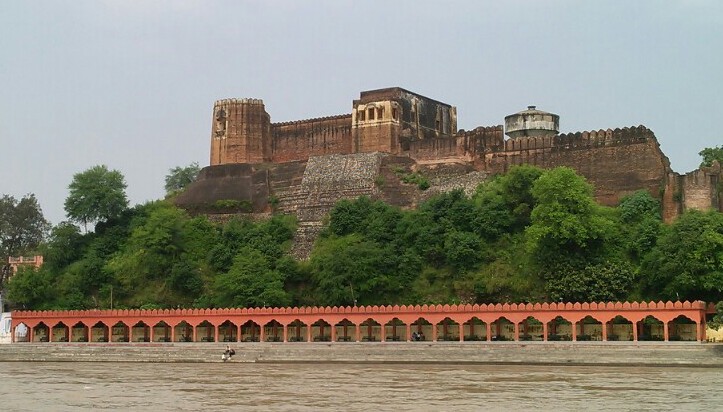
Akhnoor Fort & Jia Pota Ghat
Akhnoor, Jammu and Kashmir, India
Nearby attractions

Amar Mahal Palace Museum
Jammu, Jammu and Kashmir
A French-château palace of red brick above the Tawi — home to a 120-kg solid gold throne, Pahari miniatures and the Dogra dynasty's story.

Mubarak Mandi Palace
Jammu, Jammu and Kashmir
The Dogra maharajas' sprawling 150-year-old court complex — Rajasthani-Mughal-Baroque wings around grand courtyards, slowly being restored, with the Dogra Art Museum.

Raghunath Temple, Jammu
Jammu, Jammu and Kashmir
The 'city of temples' at its grandest — a seven-shrine 1857 Dogra complex to Rama whose interiors gleam with gold leaf and lakhs of saligram deities.

Peer Kho Cave Temple & Ranbireshwar
Jammu, Jammu and Kashmir
A Tawi-bank cave shrine of Shiva linked by legend to Jamwant the bear-king, and the city's great 1883 Ranbireshwar temple of crystal lingams.

Bhimgarh Fort (Reasi Fort)
Reasi, Jammu and Kashmir
General Zorawar Singh's stone stronghold on a Reasi hillock — treasury and armoury of the Dogra campaigns, restored with Chenab-valley views.

Bahu Fort & Bagh-e-Bahu
Jammu, Jammu and Kashmir
An ancient Tawi-cliff fort holding the Bawe Wali Mata Kali shrine, ringed by terraced Mughal-style gardens and a big riverside aquarium.

Vaishno Devi
Katra, Jammu and Kashmir
One of Hinduism's most powerful shrines — the cave abode of Mata Vaishno Devi in the Trikuta hills, reached by a 13-km uphill trail from Katra walked by nearly a crore pilgrims a year chanting 'Jai Mata Di'. The goddess manifests as three natural rock pindis.

Baba Dhansar & Karua Jheel
Reasi, Jammu and Kashmir
A spring bursting from a cliff into terraced pools beside a naturally formed Shivalinga cave — the serpent-son shrine on the Salal road, greenest after rains.